

• Home
  • About
  • Biography
  • Calendar
  • Discography
  • UNICEF
  • Photos
    • Professional
    • Candid
    • Events
    • TV
    • Bubel/Aiken Foundation
    • UNICEF
  • Videos
    • American Idol Performances
    • Bringing Broadway Home
    • Interviews
    • Montage Video Players
    • Talk Shows
    • Tours
    • UNICEF
  • Celebrity Apprentice
  • Blog Watch
  • Archive
Layout Image
Official NIP banner

Clay Aiken – Guilty Pleasure!

By musicfan123 · Comments 12086(15)http%3A%2F%2Fclaynewsnetwork.com%2F2011%2F09%2F18%2Fclay-aiken-guilty-pleasure%2FClay+Aiken+-+Guilty+Pleasure%212011-09-18+07%3A04%3A24musicfan123http%3A%2F%2Fclaynewsnetwork.com%2F%3Fp%3D12086
Sunday, September 18th, 2011

In September of 2003,  pictures of Clay Aiken were everywhere.  It seemed the press couldn’t get enough of his smiling face.  He was the new pop sensation in the United States and it seemed that everyone wanted all the news about the talented young man.

The September 3rd issue of Entertainment Weekly featured Clay on the cover of their magazine.  Inside, there were lots of pictures and an interview that was conducted while Clay was still on the American Idol Tour.    They labeled Clay a “guilty pleasure.”

Do you remember this article?  Did you buy the magazine?   AND, (gulp) do you still have the magazine?  (I do!!)


And The Geek Shall Inherit The Earth
Part Howdy Doody, part Davy Jones, 100% stud, America’s favorite redhead (sorry, Lucy!) dishes on Ruben, stardom, and that hair. Our heart’s Aiken for Clay!

By Dave Karger Dave Karger

Dave Karger, a senior writer at EW, also reports on box office and other movie- related matters on NBC’s ”Today”  Clay Aiken’s career is in the toilet.

”It smells like urine in here!” says the American Idol runner-up as he strides into the cavernous bathroom — complete with two stalls and a group shower — that’s serving as a makeshift office backstage at the Wachovia Arena in Wilkes-Barre, Pa. ”I bet you’ve never done an interview in one of these before!”

Yep, it’s a first on this end, but Aiken had better get used to the surroundings: Just hours before he’s to take the stage as part of this summer’s American Idols Live! concert tour, the potty is pretty much the only place he’s safe. Around the corner lurks a throng of ”Claymates,” as the most obsessed Aiken freaks call themselves — including beaming moms, screaming daughters, and one 27-year-old therapist who had ”Clay” permanently tattooed on the small of her back earlier in the day. When the arena lights go down, the 24-year-old special-ed teacher from Raleigh, N.C., is the performer who elicits the most earsplitting shrieks from the suburban crowd. As one oaktag sign in the cheap seats proclaims, ”Elvis, the Beatles, and now Clay.”

The correct progression might be more like ”The Monkees, O-Town, and now Clay,” but we get the picture. At some point since the cheesy early Guarini-esque ballads, the ubiquitous Ford Focus commercials, and the sad-sack lone dance move (you know the one, the shoulder pump crossed with the knee bend), Aiken has become one of the most natural, confident, and addictive voices in contemporary pop music. And thanks to his Queer Eye-popping physical makeover and his show-stopping vocal range, he’s emerged as the biggest star from Idol’s second season. Earlier this summer, his debut release, ”This Is the Night”/”Bridge Over Troubled Water,” shot straight to No. 1 on the Billboard charts, trounced the offering from American Idol winner Ruben Studdard by 200,000 copies, and became the fastest-selling single since Elton John’s ”Candle in the Wind 1997.” ”I was going to be a teacher or a principal,” Aiken says of his pre-Idol plans. ”Thank Jesus I came back for the wild-card show!”

We’ll give up a hallelujah as well. With the Backstreet Boys MIA and Justin Timberlake essentially an R&B artist, the world needs a new prince of pop. ”There’s a lot of singers that have incredible instruments,” says Steve Ferrera, RCA Records’ senior vice president of A&R, who, along with mogul Clive Davis and Idol creator Simon Fuller, is helping to oversee Aiken’s musical output. ”Clay is one of those rare singers who has the chops, but he’s also able to make the connection to the lyric. So when some people might be just doing vocal histrionics, he’s imbuing the lyric with passion and feeling.”

Although cuddly crooner Studdard won the right to release his CD first, the pair’s labels, RCA and J Records, have now pulled a Rehnquist and reversed America’s decision, opting to debut Aiken’s album on Oct. 14, a month before Studdard’s. ”It was with Ruben’s blessing,” insists a rep for both singers, adding that Studdard isn’t finished recording yet. ”He didn’t want to hold up Clay’s record.” That’s the noncynical take. Here’s another: Idol execs recognized they were wrong to throw so much weight behind Studdard during the competition. (Some speculated they did so because they were afraid to be put in the position of having to back Aiken, who was rumored to be gay. The singer has said he is straight.) Publicly, Idol judge Simon Cowell says marketing Aiken is a no-brainer. ”He is the clean-cut American boy, and he has the advantage of being able to appeal to 3-year-olds and 80-year-olds with pretty much pure pop music.” Aiken’s life story, which resonates with so many, is also a draw. ”If I was naming Clay’s album, I’d call it The American Dream, because he encapsulates all of that,” Cowell says. ”He is the American dream, which is the geeky little kid who went on to win over the hearts of America through a singing competition.” (Start lobbying, Simon: Aiken has yet to decide on an album title.) The goal for today’s hottest preteen pinup is to win over postpubescents who wouldn’t know how to text-message Ryan Seacrest if their lives depended on it. ”We’ve definitely tried to take it a little edgier than what he sang on the show,” says Ferrera, who connected Aiken with a posse of young, unknown songwriters. But don’t expect him to stray far from his comfort zone. ”There are no up-tempos on this album,” Ferrera says. ”But there are definitely some midtempo ballads.”

One of those, ”This Is the Night,” wasn’t exactly music to the Idol judges’ ears — when Aiken first performed the song, Cowell dismissed it as ”American Idol: The Musical.” ”I think they probably thought it sounded a little cheesy,” Aiken says now. ”Not as cheesy, I might say, as [Kelly Clarkson's] ‘A Moment Like This.’ I don’t care what they say — I like the song.” His fans did too: ”I don’t think they went out and bought one,” says Aiken, offering an explanation for his record-breaking sales. ”I think they went out and bought 15. I don’t know what they did with them — used them as coasters, Frisbees, something.”

Cowell, of course, has a different theory. ”If Ruben had had ‘Bridge Over Troubled Water’ on his record, he’d have had the No. 1,” says the judge, who often saved his highest praise on the show for Studdard. ”I think that was the hit song. If you asked 100 record buyers who bought Clay’s single ‘What song did you want to buy?’ I wouldn’t be surprised if 70 percent at least said ‘Bridge Over Troubled Water.’ People will disagree, but that’s my opinion.” (We’ll never know; RCA doesn’t track those statistics.)

Whatever the case, Aiken would like to put the Clay versus Ruben showdown to rest. ”The whole country wants Ruben and me to be at each other’s throats,” he says, tugging at the bottom of his orange shirt. ”We spent nine months competing with each other. And we both got what we wanted. He’s got a title, and I’m nothing but proud of him. We don’t look at who’s No. 1 and No. 2. Because it’s not worth it to us.” (Studdard puts it more succinctly: ”Clay is my dawg.”) Even after the disaster that was From Justin to Kelly, which made just $4.9 million at the box office this summer, Aiken still hopes to make a movie with his supposed nemesis. ”That was a premise that’s not necessarily original,” he says of the first Idol-inspired film. ”With Ruben and me you’ve got a completely different thing. Look at us! We could just stand there and people would laugh.”

At least they’re no longer laughing at Aiken’s looks. The budding star, whose formerly reddish brown eyebrows will completely disappear if they’re lightened one more time, says he’s totally receptive to all the fashion help. ”We were doing the video shoot for ‘This Is the Night,’ and the people from the record label were putting me in all these different outfits,” he remembers. ”I just stood there and was like, ‘That’s fine, that’s fine’ — all indifferent to the situation. They finally called my management rep and said, ‘Is he okay with these?’ If I knew enough about this industry, or enough about fashion, to know what was cool to wear, then I wouldn’t have needed American Idol to get into it. So I’ll be willing to do whatever you want me to do, but I’m going to say no if I’m really against it. There’s not really much middle ground. I’ll do it, or I’ll say, ‘That’s ridiculous.’ I pick my battles.”

For instance? ”There was a particular person who did my hair on the show,” he says. ”For a period [afterward] they said, ‘Let’s use some other people.’ And I looked like a greased pig. It was horrible. So I finally picked a battle there and said, ‘Listen, we’re getting him from now on.”’ Aiken also gladly recorded cover versions of Neil Sedaka’s ”Solitaire” and Carole Bayer Sager’s ”When I Need You” but scoffed at Rick Astley’s ”Never Gonna Give You Up.” ”I said that’s just a little corny, because there are already enough comparisons that can be drawn.” (Whaddya know? We’ve drawn them too; see sidebar.)

Still, we doubt Astley would have influenced the scores of fans who flooded the FCC with letters demanding a recount of the neck-and-neck Idol vote. ”I guess on one hand it’s flattering because people really wanted me to win,” Aiken says of the grassroots campaign. ”But it’s over. And I’m perfectly fine. I think people feel like I feel slighted. ‘Oh, poor Clay, we want to fight for him.’ You don’t need to fight for me. I’m perfectly happy. I would be much happier if these people would put their time and energy into the Autism Society. Leave the FCC alone, leave Ruben alone, leave me alone.”

Given today’s fickle pop-music world, Aiken knows that wish could soon come true. Maybe his album will be the beginning of a long musical legacy (we can dream, can’t we?). Or perhaps today’s Idol will indeed be tomorrow’s aspiring high school principal. ”How many eggs do I put into this basket?” says Aiken, his voice still echoing through the bathroom. ”In two years, am I going to be [first Survivor winner] Richard Hatch? Is this going to be my life and my career, or is this going to be a great summer-camp memory for me? I don’t know. That’s what makes it scary.” Frightening enough to make someone head straight for the john.

Comments 12086(15)http%3A%2F%2Fclaynewsnetwork.com%2F2011%2F09%2F18%2Fclay-aiken-guilty-pleasure%2FClay+Aiken+-+Guilty+Pleasure%212011-09-18+07%3A04%3A24musicfan123http%3A%2F%2Fclaynewsnetwork.com%2F%3Fp%3D12086
Categories : Clay History, Clay News
Tags : "Invisible", "This Is The Night", American Idol, Clay Aiken, Clive Davis, Dave Karger, Entertainment Weekly, Kelly Clarkson, NBC, Neil Sedaka, Raleigh NC, RCA Records, Richard Hatch, Ruben Studdard, Ryan Seacrest, Simon Cowell, Steve Ferrera, The Today Show, Tried & True

Clay Aiken – Happy, But Very Tired

By musicfan123 · Comments 10598(10)http%3A%2F%2Fclaynewsnetwork.com%2F2011%2F06%2F24%2Fclay-aiken-happy-but-very-tired%2FClay+Aiken+-+Happy%2C+But+Very+Tired2011-06-24+07%3A53%3A25musicfan123http%3A%2F%2Fclaynewsnetwork.com%2F%3Fp%3D10598
Friday, June 24th, 2011

On May 26, 2003,  Clay Aiken and Ruben Studdard made their first visit to The Today Show.  Talking with Katie Couric, both singers seemed happy, but very tired.  Clay told Katie that he didn’t even know what day it was as they had been busy since the end of American Idol.

During his interview with Katie, Clay talked about:

  • 130,000 vote difference
  • Seeing Ryan’s card and the “long name” on it
  • The whirlwind press since American Idol
  • The Idol judges and his thoughts and feelings about them
  • Clay’s past as a teacher in Special Education
  • Meeting with Clive Davis and Clay’s new record contract

While discussing some of the possible songs for his new album, Katie asked Clay to sing a bit of Solitaire.  Of course, even with no sleep, Clay sounded wonderful.  Katie also mentioned that her 7-year-old daughter was an original Claymate.

The weather was horrible as a rainstorm hit New York, but there was a huge crowd in the Plaza to see the Clay and Ruben.  Fortunately, they were under a tent to perform.  Because it was Memorial Day Week-end, their song choice was “God Bless The USA.”

There are lots of pictures of this performance and a great video.  Enjoy!!

Comments 10598(10)http%3A%2F%2Fclaynewsnetwork.com%2F2011%2F06%2F24%2Fclay-aiken-happy-but-very-tired%2FClay+Aiken+-+Happy%2C+But+Very+Tired2011-06-24+07%3A53%3A25musicfan123http%3A%2F%2Fclaynewsnetwork.com%2F%3Fp%3D10598
Categories : Clay History, Clay News
Tags : American Idol, Clay Aiken, Clive Davis, God Bless The USA, Katie Couric, Ruben Studdard, Ryan Seacrest, Solitaire, The Today Show, Tried & True

Clay Aiken – Surprise!

By musicfan123 · Comments 6784(6)http%3A%2F%2Fclaynewsnetwork.com%2F2009%2F10%2F22%2Fclay-aiken-surprise%2FClay+Aiken+-+Surprise%212009-10-22+07%3A17%3A49musicfan123http%3A%2F%2Fwww.claynewsnetwork.com%2F%3Fp%3D6784
Thursday, October 22nd, 2009

The Date:    October 22, 2003

The Show: Good Morning America

The Reason: A surprise!

Clay Aiken was back on Good Morning America a week after his promotional performance the week before.  According to reports, Clay really didn’t know exactly why he was there, but assumed it had to be about his new album, Measure of A Man.

Introduced by Charlie Gibson, Clay was dressed casually in jeans and a brown shirt.  After some casual chatting with Charlie and Diane Sawyer, they introduced a surprise guest.  Clive Davis entered the studio and Clay seemed somewhat startled.

Clive was carrying a plaque and announced that Clay had sold 613 thousand CDs in the first week of sales.  This was the highest number of sales in 10 years.  With many words of praise, Clive presented Clay with a commemorative disk which celebrated his certified double platinum CD, Measure of A Man.
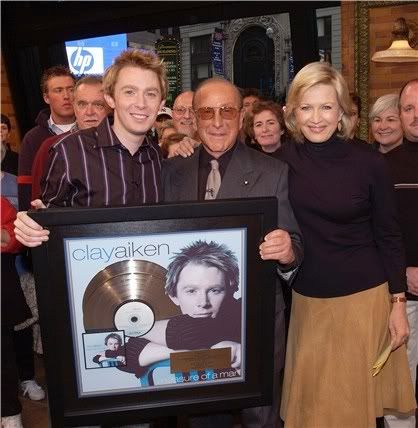
Clay’s response was fun to watch.  First, there were the looks of embarrassment, his look of thanks to the heavens, a nervous ear scratch and lots of giggles.

Both Diane and Charlie seemed excited and thrilled for Clay and the live audience gave a loud and enthusiastic response to the announcement.

This appearance on Good Morning America was short, but exciting.  I would imagine it was a moment that Clay will remember forever.
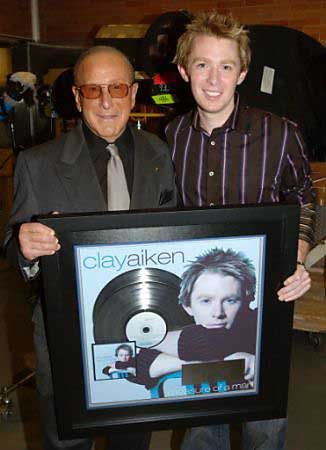
The video is great.  Look for the cute ear scratch!

httpv://www.youtube.com/watch?v=aC4wt6wB0fs


Comments 6784(6)http%3A%2F%2Fclaynewsnetwork.com%2F2009%2F10%2F22%2Fclay-aiken-surprise%2FClay+Aiken+-+Surprise%212009-10-22+07%3A17%3A49musicfan123http%3A%2F%2Fwww.claynewsnetwork.com%2F%3Fp%3D6784
Categories : Clay News
Tags : Charlie Gibson, Clay Aiken, Clive Davis, Diane Sawyer, Good Morning America, measure of a man

Clay Aiken – Do You Have Time?

By musicfan123 · Comments 6545(16)http%3A%2F%2Fclaynewsnetwork.com%2F2009%2F10%2F05%2Fclay-aiken-do-you-have-time%2FClay+Aiken+-+Do+You+Have+Time%3F2009-10-05+07%3A07%3A08musicfan123http%3A%2F%2Fwww.claynewsnetwork.com%2F%3Fp%3D6545
Monday, October 5th, 2009

A multi-page feature in Time Magazine…….that is a pretty amazing feat for any person, but especially for a young person who was thrust into the limelight only months before.  And the rumor running around the internet was that Clay Aiken almost made the cover of the magazine.

The Clay Aiken feature in Time Magazine ran in the October 5, 2003 issue and caused much talk and discussion with not only  Clay’s fans, but also the music world.  It said a lot, not only about Clay Aiken, but about the music business in general.

While reading the article again, after a few years, a few things stood out to me.

  • The author assumes the superiority of music industry tastes to those of the music-buying public.
  • Clive Davis of RCA concedes that music labels pander to radio and MTV.
  • Artists that market themselves as sex objects are not better musicians.
  • It was a mistake for the record company to characterize Clay’s fans as ones that demand “blandness.”
  • Music industry executives are out of touch with what interests the public.

Of course, when you read this article over again, you will probably see other things that catch your eye.  If so, please let us know through your comments.  I bet we could have a great discussion about this article.

Josh Tyrangiel was the editor who wrote this article about Clay Aiken.  The following information on Josh was found on the website, Digital Hollywood.

Josh Tyrangiel, Managing Editor, TIME.com: As managing editor of TIME.com, Josh Tyrangiel oversees TIME’s daily news site, which draws more than 5 million unique visitors a month and in February 2007 was named “Website of the Year” by the Magazine Publishers of America. Tyrangiel joined TIME in 1999 as a staff writer and music critic, and was named managing editor of TIME.com and assistant managing editor of TIME in September 2006. He continues to write about the music industry. Tyrangiel has written cover stories on Bono, Kanye West, the Dixie Chicks and Bruce Springsteen, as well as articles about politics, international relations, food, academia and sports. He has interviewed and profiled former Democratic presidential candidate John Kerry, former Speaker of the House Dennis Hastert, Supreme Court Justice Stephen Breyer, Houston Rockets center Yao Ming, and Oscar winners Sean Penn, Nicole Kidman and George Clooney. Tyrangiel has also twice served on the panel of judges for the influential Shortlist Music Prize. Prior to his arrival at TIME, Tyrangiel was a producer at MTV News. He also wrote for Rolling Stone and Vibe. Tyrangiel received his B.A. from the University of Pennsylvania and his M.A. in American Studies at Yale.


I hope you enjoy reading the article.


Building a Better Pop Star

10/05/2003

The record industry needs a savior. American Idol runner-up Clay Aiken could be it. Now will he play along, or is his style too far off-key?

Ask the employees at Clay Aiken’s record label, RCA, if they would listen to Aiken’s debut album, Measure of a Man, by choice, and the response is almost uniform: a lengthy pause followed by laughter. RCA was the home of Elvis Presley, and its current roster includes critical favorites like the Strokes and the Foo Fighters. It’s a rock label. Aiken, who came in second on the most recent installment of American Idol, is not only not a rocker, but, as he says in his aggressively self-deprecating way, “I’m not an artist. I’m just a guy who was on a reality show—and I didn’t even win!” Humility aside, Aiken, 24, doesn’t mind being doubted because he believes in his bones that his detractors are wrong. “There are many people at the record label who are afraid of me,” he says. “They don’t understand the reasons that someone as uncool as me is here. In a way—and this is a horrible word to say, and once I say it you’re going to print it—it’s a revolution.”

The revolution of which Aiken speaks is a TV show. In two seasons on the air, American Idol has snatched the notoriously vague process of selecting musical talent away from music executives and put it in the hands of ordinary Americans. In a convenient syllogism, Aiken believes that since everyday people chose him as their hero, those at RCA who don’t like him or his music are biased against everyday people. He may be right. It’s also possible that his denigrators love music—and the process of making music—far more than Aiken can imagine and that they resent having their passion marginalized by anyone with a telephone and a taste for Bee Gees medleys. “I don’t know why people relate to me,” says Aiken, “but my guess is that they’re tired of beautiful, cookie-cutter pop stars. They don’t believe them, and they don’t trust them.”

With Measure of a Man’s Oct. 14 release around the corner, it is now an incidental fact that Aiken did not actually win American Idol. Thirty-four million people watched last May as Ruben Studdard edged out Aiken by less than 1% of the votes. Studdard was the more polished singer, but Aiken was the better narrative. Week to week, with the help of a hair iron and contact lenses, he was transformed from a complete geek who sang show tunes into a better-looking geek who sang pop ballads. After the Idol finale, interest in Aiken surged, and his startlingly sincere first single, This Is the Night, trounced Studdard’s to become the best-selling single since Elton John’s reworked Candle in the Wind. Modern rock radio, which is dominated by hip-hop, nu-metal and irony, was overwhelmed by a wave of requests and was forced to play Aiken’s song. Rolling Stone put him on its cover and had to increase the print run to meet demand. Richard Sanders, executive vice president and general manager of RCA Records, caught on early to what he calls the “emotional connection” Aiken forged with the Idol audience, and he decided that regardless of who won on the show, RCA was going to sign Aiken. (In a deal struck with the show’s creator, Simon Fuller, RCA has the right of first refusal for all American Idol finalists. So far, the label has signed inaugural winner Kelly Clarkson, her runner-up Justin Guarini and Aiken; Studdard was signed by sister label J Records.) Sanders made his name as a music executive by signing Moby. He won’t say whether he’s a fan of Aiken’s music—”But I’m a disciple of the phenomenon,” he offers, flashing a wry smile. “There is no Ed Sullivan Show anymore, no opportunity for two or three generations to listen to music together and have a good time. I’m into being the guy that provides that.”

Many members of the RCA staff are fond of Aiken, if not his music, and are willing to go along with Sanders. But a healthy minority have curiously deep reservoirs of disdain for the Idol industry. One RCA executive, who insisted on anonymity, cited Idol as proof that “Americans have no taste” and described Aiken as “Barry Manilow, but with less talent.” Sanders says he understands that some of his employees are “skeptical about the selection process and skeptical about selling a pop artist with no credibility.” But, he adds, “I’ve told everyone they need to look at it this way: Americans buy more vanilla ice cream than any other flavor. Yes, they like their Rocky Road and Cherry Garcia, but ultimately America wants to consume vanilla. So we’re going to sell the best vanilla. Given the problems we’re facing as an industry, we cannot afford to be judgmental.” Clive Davis is not a man easily stripped of his judgment. Davis, as he often reminds people, discovered Janis Joplin, Patti Smith and Whitney Houston. Despite his status as chairman and CEO of the RCA music group, he still considers himself an A.-and-R. (artist-and-repertoire) man, which means he loves matching singers to songs. It is Davis’ job to gather material from professional songwriters for the Idol albums, oversee their production and put his stamp of good taste on every finished product. Shortly after the Idol finale, Davis invited Aiken to his home to discuss Aiken’s debut. “I told him,” says Davis, “that he is a marvelous talent and that This Is the Night is a very strong song, but it is a souvenir of a television show, and we have to get beyond that. It is my feeling that when you get into being a career recording artist, the stakes are different. People want to see if you can stretch and evolve. They want to know if you have some edge.”

Before appearing on American Idol, Aiken was a special-education teacher in Raleigh, N.C. He is a devout Baptist who does not smoke or drink, though he claims to have a temper that emerges when he sees “people with disabilities treated like they’re 4 years old.” In his piety, Aiken can make Billy Graham seem like a rogue. He listened to Davis’ advice about edge and then respectfully asked that he not be required to sing any songs about sex. “Clive tried to tell me that saying certain words in a song—or as he says, ‘putting some balls into it’—isn’t bad, it’s just strong emotion,” says Aiken. “Well, there are certain words and emotions I don’t want kids hearing, and I’m not changing because they think it’s going to sell better. This is going to sound horrible, but I got 12 million votes doing what I did.”

Davis counters that Aiken is no longer selling to a TV audience. “You can’t worry about who bought the last single,” says Davis from his seat in an office studded with platinum-record plaques. “You can’t be paralyzed by what the public expects of you. We’re now competing against Justin and Christina and Avril and Pink, and if you allow the television audience to program your music, you will not be on radio and you won’t make MTV. And then where are you? We have to stay ahead of the curve.”

Aiken had been forewarned by Clarkson and Guarini that if he was happy with 50% of his completed album, he’d be “doing real good.” The problem, they told him, was that there were too many people wrestling for control of their music. “Simon Fuller did not create American Idol to be in the television business,” says Tom Ennis of Fuller’s production company, 19 Entertainment. “He created American Idol as a new way to find talent to manage and nurture.” 19 is the Idols’ official record label—RCA is the American distributor—and Fuller, who managed Annie Lennox before inventing the Spice Girls, is Davis’ contractual equal in choosing music for the Idol albums.

Here’s where the American Idol business gets dicey. Davis would like RCA to curate the careers of artists; Fuller wants his Idols to have long recording careers too, as long as they don’t forsake the Idol audience. (Fuller was incensed that Davis spent eight months refining Clarkson’s debut for radio rather than getting it to market as soon as possible.) “You have to serve many masters when you have that many people with a vested interest in you,” says Ennis. “You can’t skew yourself one way and not speak to the people who spent all that time watching you and voting for you.”

Ennis and 19 have market research on their side. As Davis suggests, avid music fans expect their stars to evolve. But the Idol audience, which has an unprecedented ownership stake in Aiken’s career, is not made up of avid music fans. A disproportionate number of copies of This Is the Night were sold at Wal-Mart and Target stores, and a large number of those discs were picked up in the check-out lane, where Sanders positioned Idol merchandise to catch the eye of people who wouldn’t think of stopping in the music section. “Our consumer is the middle 80% of the population,” says Gerry Lopez, president of Handleman Entertainment Resources, which stocks and manages music offerings at such stores as Wal-Mart. “These are moms and dads making $26,000 to $36,000 a year … We’re not catering to Napster or Kazaa folks, just people who like a nice song sung by a nice kid.” Because it pays the full retail price and doesn’t download music, the Idol audience is a record company’s dream; because it doesn’t have indulgent, wide-ranging tastes, it can be an artist’s nightmare. Studdard got so frustrated trying to tailor his upcoming album, Soulful, to the Idol audience that in early July he called his various managers and label representatives and, according to several sources, threatened to quit. “This is my car,” Studdard said, according to an executive who was on the call. “If you guys want to navigate, that’s great. If you guys want to drive, then you better get a new car.” Studdard is now working with Missy Elliott and R. Kelly on what an RCA executive termed “a credible, clean hip-hop album.”

If Studdard appears to be a Clive Davis kind of guy, then Aiken definitely sides with Fuller. “Simon Fuller is the one person I trust in all this,” says Aiken, and the proof is on Measure of a Man, which is the rare pop album completely free of innuendo, let alone sex. Instead of adding edge lyrically, Davis and another A.-and-R. executive, Steve Ferrera, were forced to play with Aiken’s sound, using crunchy power chords in place of benign synth pads and encouraging Aiken to put some power into his ballads. Says Aiken: “I’m very satisfied with my album. I grew as a singer, and Clive deserves a lot of the credit for that.”

Still, pop isn’t just music. It’s a package, and Aiken has had numerous frustrations with the way RCA has tried to tweak his image. Everyone—label, management and Aiken—was thrilled with Aiken’s Rolling Stone cover shoot, so photographer Matthew Rolston was hired to direct a video for This Is the Night. In it the story line was … Clay Aiken does a magazine photo shoot. “They had me in this tight little vintage T shirt and jeans and a leather jacket,” says Aiken. “And (Rolston) had me sing the song in one scene with this angst attitude—popping my neck and mean looks on my face … It’s trying to make me somebody I’m not. I’m not mean, and this is something the label just doesn’t get. ‘How the heck do we market this boy? We’re used to marketing Christina Aguilera and Dirrty. We can’t market clean!’”

Aiken laughs off most of RCA’s foibles—like the time he was forced to change his unstylish shoes before appearing at an industry convention, or the airbrushing of his eyes on the Measure of a Man album cover—because he believes that the label is clueless about how to market to an audience he knows instinctively. “I’m a battle picker,” he says. “I try not to get upset about all this marketing stuff because I’m saving it for the time that they tell me that I need to do a song about ‘Let’s hook up and have sex.’ But I’m like, ‘Do not—ugh!—don’t pretend that the public are a bunch of idiots! Don’t pretend that you know what they want and they don’t know what they want.’ That’s the stupidest thing I’ve ever heard in my life!” Of course, anticipating the tastes of the public—knowing that the world might be ready for a black woman to sing about respect, for example—is exactly what great creative executives do. They don’t make art, but they facilitate it, fight for it and nurture it, often in the face of public opposition or apathy. Record companies have always made plenty of music aimed at the heart of the market, but the frustration of the anti-Idol RCA executives—and many others throughout the industry—comes down to timing. At the exact moment that American Idol has created a surge of people who buy their music with their mints as an impulse item, file sharing has siphoned off nearly all the adventurous record buyers. That leaves a whole lot of people buying Sanders’ vanilla and very few interested in his Rocky Road.

It is telling that in just five months with RCA, Aiken has won most of his battles. The This Is the Night video was scrapped at considerable expense. His album is family-friendly pop. Aiken got to name his record Measure of a Man, even though Davis lobbied for any other title. The marketing department now says its strategy is to “let Clay be Clay.” “Revolution is a strong word,” says Aiken. “But RCA would not have picked me or Ruben. Simon Cowell would not have picked us. America has shown them that they don’t know what they’re talking about.”

Josh Tyrangiel, TIME Magazine


Comments 6545(16)http%3A%2F%2Fclaynewsnetwork.com%2F2009%2F10%2F05%2Fclay-aiken-do-you-have-time%2FClay+Aiken+-+Do+You+Have+Time%3F2009-10-05+07%3A07%3A08musicfan123http%3A%2F%2Fwww.claynewsnetwork.com%2F%3Fp%3D6545
Categories : Clay News, Editorial
Tags : Clay Aiken, Clive Davis, Josh Tyrangiel, Time Magazine

Celebrity Apprentice: Clay’s Presentation

Chat

chatbox popout

Follow Us!

Follow Us on FacebookFollow Us on TwitterFollow Us on RSS

Search

Quote of the Day

It is not always about performance art, but about receiving positive energy from people with positive spirits. Sometimes we can see someone's spirit, and those are the people with great energy. Those are the people that get me through the day, especially on Broadway. -Clay Aiken

Subscribe To Clay Aiken News Network


Enter your email address:

Delivered by FeedBurner

Upcoming Events

    There are no events.
More » « Previous     Next »

CANN Radio

Clay's Websites

  • Clay Aiken Fan Club
  • Clay Aiken iLike Page
  • Clay Aiken Myspace
  • Clay Aiken on Facebook
  • Clay Aiken YouTube Channel
  • National Inclusion Project
GoodSearch
& GoodShop
YOU SEARCH OR SHOP
WE GIVE!
Search the Web now Free coupons at top stores
Raise money for National Inclusion Project - Bubel Aiken Foundation - BAF  just by searching the web and shopping online!
Search the Web now
Search the web now!
Free coupons at top stores
Free coupons at top stores!
Add GoodSearch and GoodShop to your site Add to your site

Meta

  • Register
  • Log in
  • Entries RSS
  • Comments RSS
  • WordPress.org

Visitor Map

Locations of visitors to this page
Clay Aiken News Network
Copyright © 2012 All Rights Reserved
iThemes Builder by iThemes
Powered by WordPress